Writing
Fit AI into the process you already run
UiPath spent its September conference arguing that the hard part of enterprise AI is the map, not the model. That matches what we see inside real workflows.
Writing
UiPath spent its September conference arguing that the hard part of enterprise AI is the map, not the model. That matches what we see inside real workflows.
On September 23, UiPath used its Fusion conference to launch a tool called Cartographer and an idea it calls the Map of Work (opens in a new tab). The argument from founder Daniel Dines is that the hard part of enterprise AI is not the intelligence. It is the map.
We are not a UiPath shop and this is not a product review. But that framing is the closest thing to our own experience that we have seen a large vendor say out loud.
Dines describes a modern model as brilliant and also a stranger in your building. It does not know what a payment approval means at your company, who is allowed to sign one, or when to escalate. It shows up gifted and new every day, with no memory of you.
That is the part teams underestimate. The intelligence arrives for free now. What does not arrive is the thing your AP lead knows about which supplier's freight charges always run over and always get paid anyway. Or the approval step everyone bypasses on the last day of the quarter. That knowledge is real, it is load bearing, and almost none of it is written down.
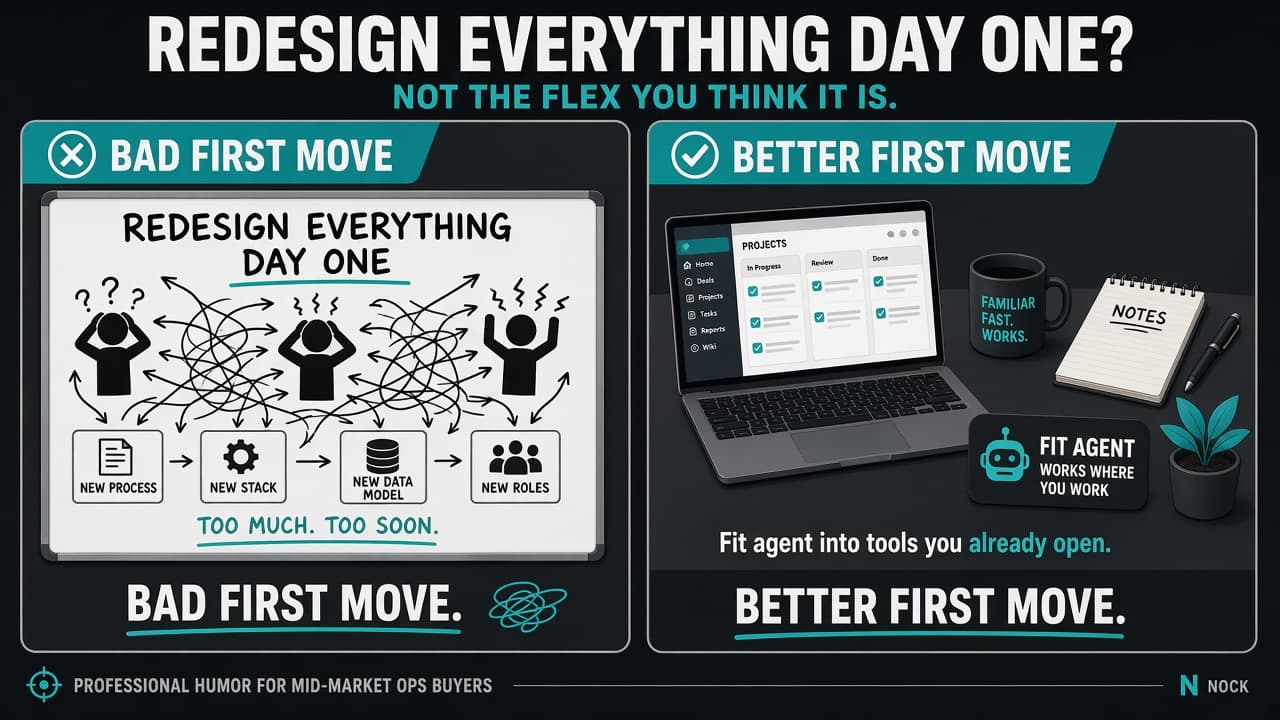
So the instinct to redesign the whole process around AI on day one is understandable and usually wrong.
A workflow people already trust carries years of encoded exceptions. Nobody documented them, but they are in there, in the order of the steps and in the habits of the people running it. A rebuild discards all of that on day one and then asks the team to relearn their job at the exact moment the new system is least reliable.
The CIO write-up of the launch makes the same point from the other direction. Reporting on Cartographer (opens in a new tab), Stephanie Overby notes that it is precisely the undocumented exceptions and judgment calls that have kept the messiest processes out of automation's reach. The blocker was never the model. It was that the process description was fiction.
Our version of this is less grand and more boring. Before we design anything, we sit with the process and draw three things.
Then the agent gets built around those, inside the system the team already has open. Not beside it. Inside it.
That ordering matters because it changes what you are asking the agent to do. An agent in a tool nobody opens is a demo. An agent in the tool someone already has open all day is a coworker who does the first pass.
Authority should be earned by the work rather than granted to the model up front. Start narrow. Let the system handle the pass that used to eat an afternoon and hand a person the part that needs a decision. When it has been right for a few weeks on the narrow thing, widen it.
Worth noting that even UiPath is not promising a complete picture at the start. Dines said on stage that first drafts of a Map of Work "will be incomplete for sure." Mark Geene, who leads agentic solutions there, put the goal as capturing enough to get agents executing and getting live early. That is the right posture. A map you can improve beats a specification you cannot finish.
Sometimes the honest answer after mapping is that the process itself is broken, and no agent will save it. That happens. It is a real finding and worth the mapping exercise on its own.
But it is a conclusion, not a starting assumption. Redesign after you understand what the current process is actually doing, including the parts that only exist in someone's head. Not before.
The uncomfortable part of all this is that the work is organizational, not technical. Doug Marcey, CTO at Coronis Health, told CIO the hard problem is change management at the organizational level. We would agree, and we would add that this is exactly why it gets skipped. Mapping exceptions is unglamorous. It is also the whole job.
No pitch required. Name the team and what the work costs them in a week. That is enough to tell whether we are useful.
Related
#AgenticAI #ProcessAutomation #MapOfWork #MidMarket #NockAutomation
No pitch required.
Name the team and what the work costs them in a week. That is enough for us to tell you whether we are useful.
Get in touch