Writing
Agents inside the tools people already open
Adecco is putting an agent into the daily workflow of 27,000 staff. The detail worth copying is not the scale. It is that there is one entry point instead of dozens.
Writing
Adecco is putting an agent into the daily workflow of 27,000 staff. The detail worth copying is not the scale. It is that there is one entry point instead of dozens.
On September 15, the Adecco Group announced (opens in a new tab) that it is rolling out Salesforce's Agentforce Coworker across more than 40 countries, after pilots in the UK and France. It reaches the daily workflows of 27,000 employees, sits inside Salesforce, and runs on Anthropic's Claude.
Numbers like that are easy to read as a story about scale. We think the more useful detail is buried in the middle of the release.
Adecco describes the rollout as giving colleagues a single point of access to data, systems and organizational knowledge that previously sat across dozens of tools.
That sentence is the whole design decision, and it is the opposite of how most AI gets introduced. The common pattern is that the agent becomes tool number thirty one. It has its own tab, its own login, and its own place in a browser window that is already full. Then adoption quietly fails and everyone concludes the model was not good enough.
Recruiters and sales staff in that rollout are not being asked to go somewhere new. They find priority prospects, prepare briefs, enrich data, check lead status, select candidates, and launch a screening or onboarding agent from the place they were already working.
We have written before that most automation failures are adoption failures. The tool sits beside the workflow rather than inside it, nobody owns the exceptions, and the team goes back to the spreadsheet.
The Adecco framing suggests the same conclusion from a company with far more resources than the teams we usually work with. CEO Denis Machuel said their pilot showed strong adoption in a matter of days. Whether or not that generalizes, the mechanism is plausible. Adoption is fast when the thing appears where people already are and slow when it asks for a new habit.
Worth saying clearly that these are Adecco's and Salesforce's characterizations of their own deployment. We have no independent view of how it is going, and a press release at Dreamforce is not an audit. We are borrowing the design decision, not the outcome.
Most companies do not have an unlimited enterprise agreement or 27,000 seats. The transferable part costs nothing.
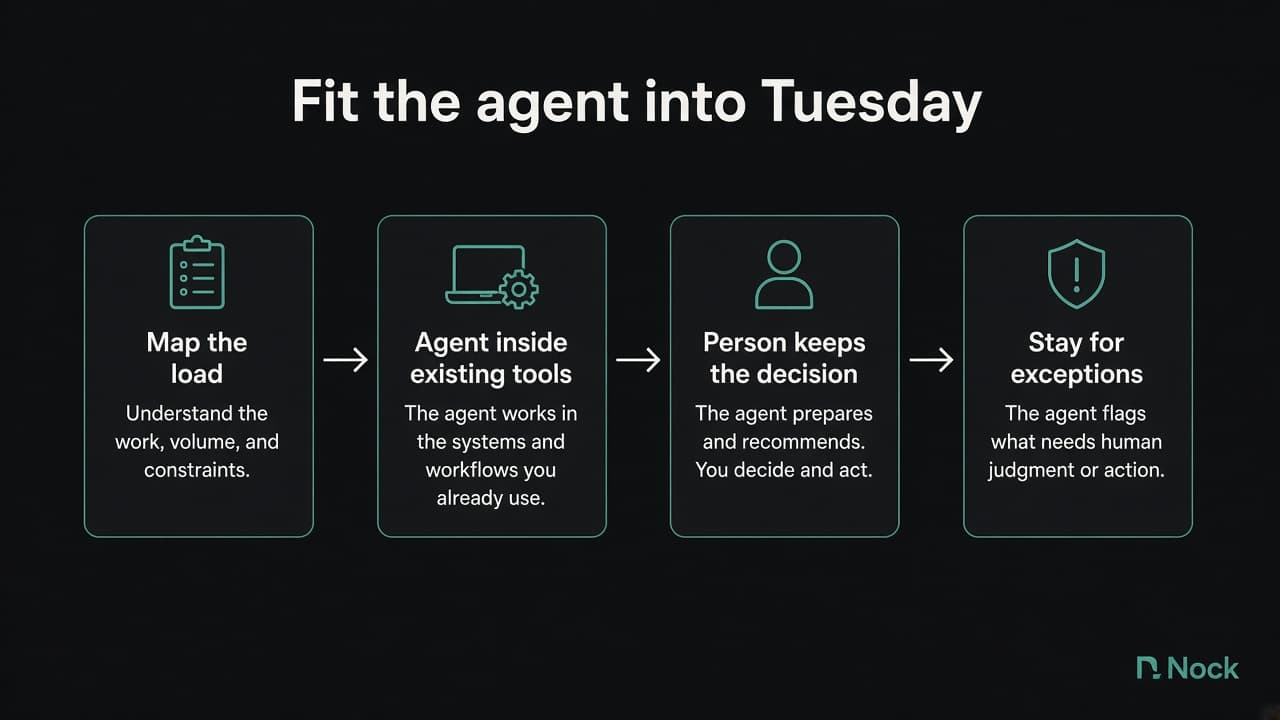
Before building anything, answer one question. What application does this team already have open at 10am on a Tuesday? That is where the agent goes. If the answer is a shared inbox, build there. If it is a CRM, build there. If it is a spreadsheet, build there, even if a spreadsheet offends your architecture diagram.
The corollary is that a beautiful standalone interface is usually a warning sign. It means the work of integration got deferred, and integration is where adoption lives.
The line from Machuel we keep coming back to is about a single interface that knows candidate history and client context for the moment when human judgment matters the most.
That is the correct division, stated by someone selling the opposite of caution. The agent assembles the context. The person makes the call. In their framing it frees teams to focus on richer engagement with candidates and clients, which is another way of saying the machine took the preparation and left the conversation.
Preparation is most of the clock in a lot of jobs. Pulling records, checking history, assembling a brief, drafting the first version. It is also the part people least enjoy. Taking it away is not a small win just because it is unglamorous.
If we were running this internally, two things would tell us whether it was working, and neither is a usage dashboard.
First, does anyone own the exceptions. When the agent surfaces something odd, there has to be a named person whose job includes deciding what happens next. Unowned exceptions are how a rollout dies six weeks in, politely.
Second, did the saved time land somewhere visible. Hours that disappear into general busyness are indistinguishable from hours that were never saved. Hours that turn into more candidate conversations are a result you can describe without inflating it.
Scale makes headlines. Placement and ownership decide whether anything survives to Tuesday.
No pitch required. Name the team and what the work costs them in a week. That is enough to tell whether we are useful.
Related
#Agentforce #DigitalLabor #WorkplaceAI #Adoption #NockAutomation
No pitch required.
Name the team and what the work costs them in a week. That is enough for us to tell you whether we are useful.
Get in touch